
Funding for federal student aid programs was first authorized in the 1960s and 1970s and has increased dramatically to keep up with the skyrocketing costs of college. Yet, despite this increased aid, negative patterns of inequalities in college attendance, low completion rates, and high student debt continue. It’s become clear that a new approach might be needed: one that focuses on college affordability and access.
The Education Department has released its annual list of the country’s most expensive colleges, both private and public. For 2011-12 academic year, Columbia University narrowly edged out Sarah Lawrence as the college with the highest tuition in the U.S., at $45,290 per year. This does not include room and board, books, or college fees, which push most of the most expensive colleges’ list prices far above $60,000.
Confused about your student loan options? This cute video from Planet Nutshell explains the differences between federal subsidized and unsubsidized Stafford loans, parent PLUS loans, and graduate PLUS loans in simple terms.
It’s news to no one that the cost of attendance at U.S. colleges has risen dramatically over the past thirty years, leading more students to rely heavily on student loans and become burdened by debt. In the video below, David Lin, an economics professor at American University, explains why tuition costs have increased so quickly […]
Believe it or not, private colleges are now offering more financial aid than ever. Of course, with college costs rising, it make sense for financial aid to adjust accordingly. However, it’s not just the amount of grants and scholarships that’s increasing–it’s the percentage of the overall tuition total. According to Time Magazine, in a survey […]

With the high cost of application fees and college visits, most high school students can’t afford to apply to every single college that interests them. Parents and students need to weigh many different factors, such as cost, location, size, and value. With so many options, the choice can seem overwhelming.
Students and families shopping around for the best college for their money might be initially turned off by most schools’ high costs of attendance. But most students and families don’t pay a school’s sticker price–in fact, many pay significantly less, or even nothing, for their college educations. Check out this video to learn about net price calculators and how they can help you determine the real cost of college.

Did you know you could get a scholarship for college for being tall, a vegetarian, or a Star Trek fan? Check out these 5 usual college scholarships for things you’d never expect.
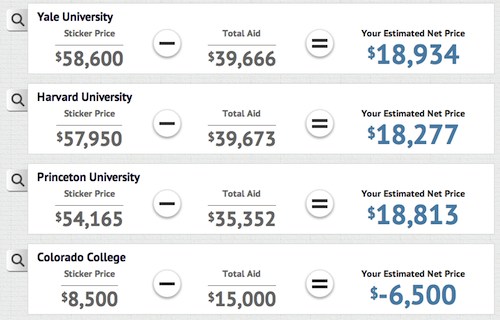
Comparing financial aid letters from different colleges can be confusing. It’s hard to know exactly what you’re paying for, what your final sticker price will be, and whether one offer is better than another. The College Abacus helps solve this problem, allowing you to compare the real cost of colleges after all aid has been applied.

Now that you’ve chosen a school and are ready to submit your seat deposit, it’s important to remember to take care of all your financial and loan obligations before you graduate. Check out this financial aid timeline from The College Board to make sure you’re staying on top of financial aid deadlines and forms.