
While salary shouldn’t be your only consideration when choosing a college major, it’s certainly something that you should take into account when deciding how much you can afford to invest in a college education.
If you know you’re planning on entering one of these lower-paying fields, it may not make financial sense to take out hundreds of thousands of dollars in student loans.
Of course, there are always exceptions to the rule. Just because a field has low starting salaries doesn’t mean there’s no room for growth. For example, Anthropology majors make an average of just $36,200 at the beginning of their careers, but jump to $61,400 by mid-career.

Planning on entering public service after college so you can have your student loans forgiven? It’s more complicated than you think.
Think about how often you change your mind. There’s no way to be completely certain that your plans won’t change sometime in the next four years–or in the ten years you have to commit to a public service position in order to be eligible for student loan forgiveness.
This video from Reuters TV offers a year-by-year plan for high school students and their parents to help them prepare for college. It includes some great tips on saving for college and how to get the most financial aid possible.
Want to apply to college, but worried about all those application fees adding up? The College Board wants to help you.
If you got a high score on your SAT or PSAT, you may soon be receiving a package that will make it free to apply to 6 colleges of your choice, the New York Times reports. The College Board is sending fee waivers to about 28,000 seniors who scored in the top 15 percent of test takers and whose family is in the bottom quarter of income distribution.
Are colleges adequately preparing graduates to enter the workforce? Why are so many college graduates unemployed? Is online education as effective as traditional in-person classes? A new survey from Northeastern University attempts to answer those questions and more. College graduates not ready for a career The study revealed that nearly two-thirds of Americans believe the higher […]
With college graduates entering a still-shaky economy, graduates’ salaries are becoming an increasingly important metric in the college ranking game. But is there too much of a focus on future pay and not enough on the quality of education colleges offer?

I love a good buffet. Health hazards aside, what’s not to like about getting to choose from a multitude of options, taking as little or as much of each as you like?
Increasingly, college students are taking the “buffet approach” to higher education. A few AP classes there, some time at a traditional brick-and-mortar campus, a couple classes at a local community college, and some MOOCs or other online classes thrown in.
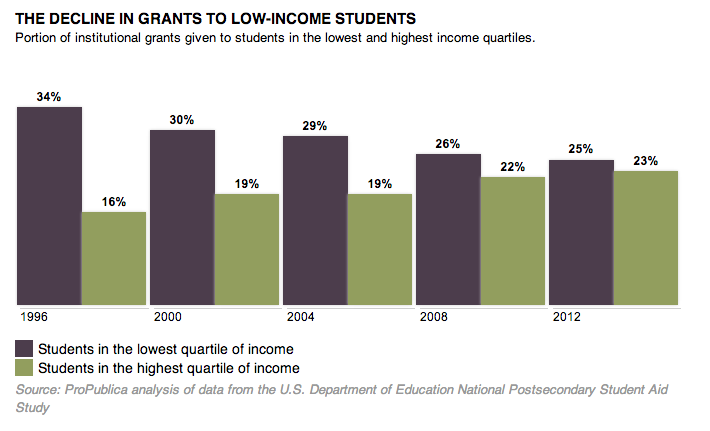
A new investigation from ProPublica has found that public colleges and universities are increasingly giving less financial aid to poor students in favor of wealthier ones. Even through the economic recession, public schools continued to favor high-income students in favor of students who need the money the most. The chart below shows that from 1996 through 2012, […]
When deciding whether a college’s price tag is worth the investment, it’s important to consider your major and career aspirations. While no major can guarantee financial success, a recent study from Georgetown University found that your college major can significantly impact your future earning potential.
We don’t recommend choosing your college major based on average salary alone, but it’s certainly something you should consider when deciding whether to take out student loans to pay for college and how much debt you can handle.
Today, U.S. News released its famous annual list of America’s Best Colleges for 2014. Some publications have criticized the famous annual U.S. News & World Report rankings of America’s top colleges for putting too much emphasis on prestige and not enough on affordability, but these rankings are still widely respected and cited.
The overall rankings are broken down into 4 categories: National Universities, National Liberal Arts Colleges, Regional Universities, and Regional Colleges. Princeton University takes home the top ranking for National Universities, while Williams College grabbed the top spot in the Liberal Arts College rankings.