
It’s an age-old question that’s been debated by philosophers from Socrates to The Notorious B.I.G.: Does mo’ money equal mo’ problems? It just might, if that money is being taken out to pay for college. Graduates with student debt are less happy Many students and families think that attending a prestigious, well-known college is the […]
Is a college degree worth the cost? Should everyone go to college? In the video below from CNN Money, “Freakomics” author and journalist Stephen Dubner answers these questions about higher education and offers his take on the rising cost of college. Dubner says that, overall, getting a college degree pays off over time. If, however, […]

While most in the media tend to focus on ultra-low acceptance rates of Ivy League colleges, in reality, most colleges aren’t nearly that competitive.
In fact, at most public and private colleges, the acceptance rate is over 50%.
According to the National Center for Education Statistics, 84% percent of public colleges admit at least half of all students who apply, and 80% of all private, not-for-profit colleges do.
And these less competitive colleges enroll significantly more students than the small number of schools that have lower acceptance rates.
Tennessee may be known for its great weather, country music and being Elvis’s hometown, but that might soon change.
According to ThinkProgress, in April, Tennessee lawmakers passed a bill that will make tuition free for all high school graduates who go to a two-year college as long as they meet the requirements of the “Tennessee Promise” program.
As part of the program, after graduating from high school, students will have to maintain a 2.0 grade point average, attend mandatory meetings, work with a mentor, and do community service. As long as they fulfill these obligations, their college education is free.

It’s well-documented that student debt has grown rapidly over the past decade. The class of 2014 graduated with an average $33,000 in student loans per student, and the numbers will likely be event greater for next year’s class.
Given that student loan debt is increasing while salaries are declining, it’s not surprising that many young adults are struggling to accumulate wealth.
According to a new report from the Pew Research Center, it’s become increasingly difficult for young adults with student debt to save up enough money to buy a house, get married or start building their ‘nest egg.’
We work with many students who think that if they can just get into an elite college, their future prospects and lives will be better. But according to a new survey, this isn’t necessarily the case. In fact, it’s even possible that attending an elite college could make your life worse–if you take on significant […]
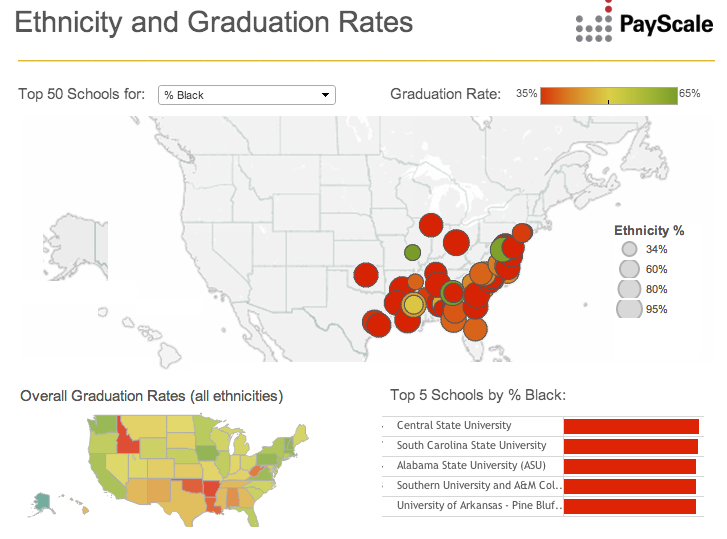
Choosing the right college can be tough. With over 3500 colleges in the United States, finding that perfect match–let alone paying for it–is no easy task.
The folks at PayScale have put together an interesting interactive map that shows the top colleges for different ethnic groups, along with their graduation rates, locations and returns on investment after 20 years.
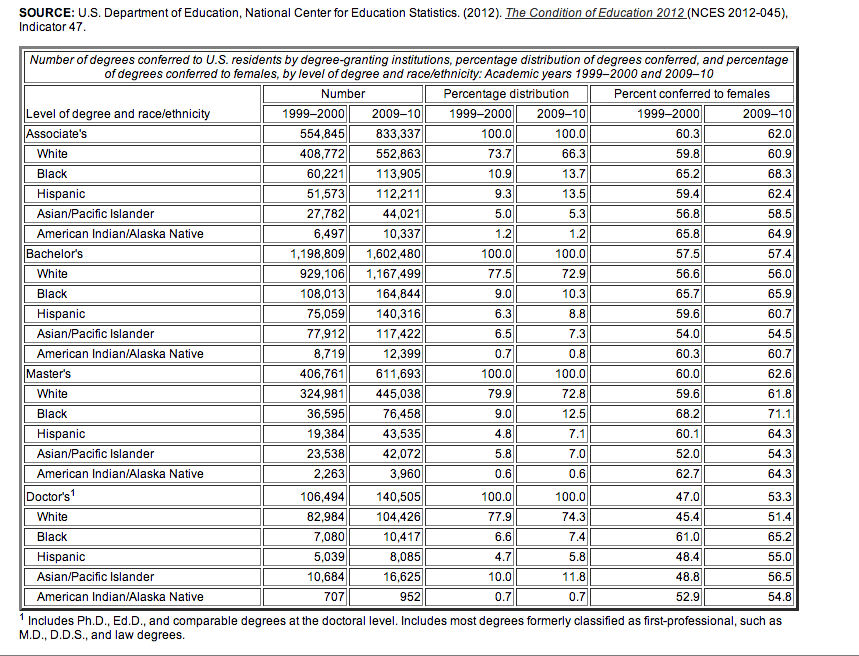
While many higher education advocates are worried because the national college graduation rate is a less-than-stellar 54%, there’s a silver lining: more college graduates are identifying as an ethnicity other than White.
According to The National Center for Education Statistics, in 2009-2010, over 27 percent of all bachelor’s degrees were awarded to students who identified as Black, Hispanic, Asian/Pacific Islander, or American Indian/Alaska Native.
That’s up from the previous recorded year of 1999-2000, when 22.5 percent of bachelor’s degrees went to students who identified as an ethnicity other than White.
Starting your bachelor’s degree at a community college can be a great way to save money and still graduate with the same degree as students who attend a 4-year college from the beginning.
But if you choose to go the community college route, you’d better be careful–a new report from the Graduate Center of the City University of New York found that more than 40% of community college graduates are unable to transfer their credits to a 4-year college.
College applications were down this year at many top colleges, including Harvard and Dartmouth. This has led some in higher education to worry whether we’ll start seeing fewer people completing college degrees. It’s even caused some colleges to be forced to close. Law schools cutting tuition to attract students Many law schools have seen similar declines […]