Are you planning on taking out student loans to pay for college? It’s important to have a plan in place before taking on too much student debt. Remember, unlike other forms of debt, student loans can’t be discharged if you declare bankruptcy.
When choosing a college, it’s important to keep future student debt in mind. Forbes advises that students should keep college debt below their expected first year’s salary. While this may seem impossible given the rising cost of college, it demonstrates the need to be diligent in your college search to find a school that offers significant financial aid while providing a quality education.

I love a good buffet. Health hazards aside, what’s not to like about getting to choose from a multitude of options, taking as little or as much of each as you like?
Increasingly, college students are taking the “buffet approach” to higher education. A few AP classes there, some time at a traditional brick-and-mortar campus, a couple classes at a local community college, and some MOOCs or other online classes thrown in.
This summer, college students and their parents narrowly avoided a student loan interest rate hike that would have raised interest rates on new subsidized Stafford loans from 3.4 percent to 6.8 percent. The deal set Federal Stafford Loans for undergraduates at 3.85%, Graduate PLUS loans at 5.4%, and Parent PLUS loans at 6.4%.
While college-bound students and their families breathed a collective sigh of relief, the deal came with a catch: student loan interest rates would be tied to the health of the economy. If the economy improves as economists predict, rates would increase in coming years. In fact, rates would likely climb higher than they were this past spring.
For families who have saved for college with a 529 plan, the new deal presents an interesting conundrum. Should you use the funds in your account now to pay for your student’s education or save them for the future, when it might be more expensive to borrow?
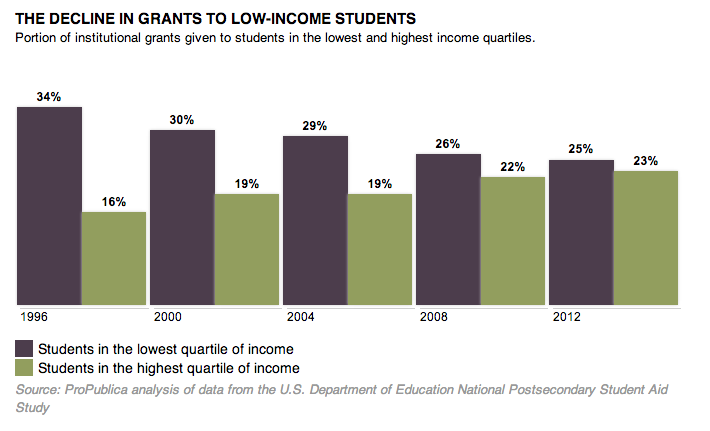
A new investigation from ProPublica has found that public colleges and universities are increasingly giving less financial aid to poor students in favor of wealthier ones. Even through the economic recession, public schools continued to favor high-income students in favor of students who need the money the most. The chart below shows that from 1996 through 2012, […]
Today, U.S. News released its famous annual list of America’s Best Colleges for 2014. Some publications have criticized the famous annual U.S. News & World Report rankings of America’s top colleges for putting too much emphasis on prestige and not enough on affordability, but these rankings are still widely respected and cited.
The overall rankings are broken down into 4 categories: National Universities, National Liberal Arts Colleges, Regional Universities, and Regional Colleges. Princeton University takes home the top ranking for National Universities, while Williams College grabbed the top spot in the Liberal Arts College rankings.
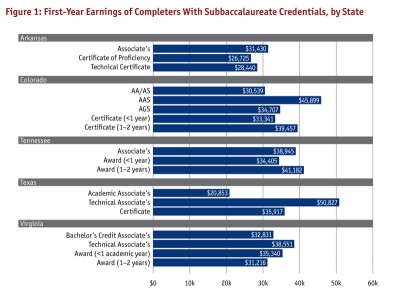
Many students and parents assume that attending an elite, well-known university is the key to a great career and future financial success. But that’s not always the case.
A recent study found that graduates of regional and second-tier colleges, on average, earn about the same as those who go to prestigious flagship universities. And surprisingly, it also confirms that students with associate’s degrees often out-earn bachelor’s degree-holders.
Even if you’re only a high school freshman, it’s never too early to start thinking about college.
Planning ahead can help keep high school students on track so they are well-prepared for college, instead of scrambling to choose a college and fill out applications at the last minute.
President Obama’s recent signing of the bill to keep student loan interest rates low is a move in the right direction toward helping students afford college. But as we’ve discussed, it’s not enough. In the video below from Democracy Now, Rolling Stone editor Matt Taibbi discusses how the high price of U.S. college tuition is the real […]
We often hear about student debt as a problem for recent college graduates in their 20s and 30s. But it’s not just young adults who are struggling to pay back their loans. Their parents are suffering as well.
Americans ages 50-59 owe a combined $112 billion in student loans. That’s triple what they owed in 2005. Why the dramatic increase? Because many parents are taking out additional loans to pay for their children’s education, despite still paying off their own student loan debt.

What’s the most powerful force in the universe, according to Albert Einstein?
It’s not gravity. It’s not even love.
It’s compound interest.